About Us
Vision and Mission
Our Vision
A world of global citizens in solidarity and community, inspired by their faith, working for peace, social justice, democracy, and sustainable development.
A nation rooted in God-centered values and empowering culture, with democratic leaders and engaged citizens forging a just, prosperous, sustainable, and peaceful society.
A Mindanao that enjoys sustainable peace and development, thriving in the diversity of its cultures and faith traditions.
Our Mission
We in the Ateneo de Davao University educate students through excellent academic instruction, robust research and innovation, and vibrant community engagement and advocacy for social transformation.
Our education is rooted in the formation of values that are based on our Christian, Catholic, Ignatian, and Jesuit tradition.
We aim to produce discerning leaders and citizens distinguished by their character, competence, compassion, conscience, courage, cultural-rootedness, and commitment to community and the common good.
Councils, Committees, and Special Units
1. President’s Council
The President’s Council serves as the advisory body of the University President in terms of policy decision-making. It shall keep the University President informed on questions, issues and problems in the various units.
The Council is chaired by the University President and is composed of the Assistant to the President, Academic Vice President, Director of Ignatian Spirituality and Formation Office, Deans, High School Principal, Grade School Headmaster, the University Treasurer, the Director of Human Resource Management and Development Office, the Director of the Physical Plant Office, the Director of University Information Technology Office, a representative from the Jesuit Community. The council may also assist the University President in administrative issues that may affect the entire University.
2. University Councils
- University Academic Council
- University Research Council
- University Community Engagement and Advocacy Council
- Basic Education Council
3. University Academic Council
The Council is an advisory body in terms of academic policies and programs set for the undergraduate, graduate and postgraduate programs of the University. The Council is chaired by the Academic Vice President.
4. Standing Committees of the University Academic Council
The University Academic Council has standing Committees designed to respond to all academic matters. The chairpersons of these Committees are appointed by the Council while members of the Committees are nominated by the chairpersons for approval by the Council.
a. Committee on Curriculum
b. Committee on Standards
c. Committee on Honors and Awards
d. Committee on Student Affairs
e. Committee on Student Services
f. Library Committee
5. Disciplinary Board
The Disciplinary Board of various units is tasked with the responsibility of adjudicating infraction of school rules and regulations committed by students.
The University maintains good school discipline inside the campus as well as outside the school premises when students are engaged in activities authorized by the University. The Board has the right to recommend the imposition of appropriate and reasonable disciplinary measures in case of major offences or infractions of rules and regulation of the University. However, no cruel or physically harmful punishment shall be imposed or applied against any student.
When the offense committed is serious and circumstances so warrant, the appropriate academic personnel shall cause the filing of the corresponding administrative action against the erring student to the Board. No disciplinary sanction shall be applied upon any student except for cause as defined in the rules and regulations of the University and the Manual of Regulations for Private School, and after due process shall have been observed. The punishment shall be commensurate with the nature and gravity of the offense.
6. University Budget Committee
The University Budget Committee serves as an advisory body to the University President in terms of ascertaining the periodic, annual and long – term budgets of the University. It is chaired by the University Treasurer.
The Committee assists the University Treasurer in finalization of the University budget for presentation and approval of the President. It reviews budget proposals submitted by various unit heads and administrators of the University. It conducts budget hearing to determine priorities and submits recommendations to the University President.
7. Committee on Faculty Rank and Promotions
The Committee on Faculty Rank and Promotions serves as the advisory body to the University President relative to matters pertaining to faculty rank, regularization, appointments and promotion. The Committee meets at the end of the every school year after the unit heads have consolidated all the faculty profile for re-ranking and promotion purposes. There shall be a committee in Grade School, High School and in College. In the basic education, it is chaired by the Headmaster and Principal respectively. In College, the Deans select from among themselves the chair of the Committee.
Members of the Committee are appointed by the University President but not limited to two (2) senior faculty, representatives from the Faculty Clubs, the Unit Heads, Assistant Headmasters, Assistant Principals, and Assistant Deans.
8. Committee on Faculty Development
The Committee on Faculty Development serves as the advisory body to the University President relative to matters pertaining to faculty development. The Committee meets twice every school year after the submission of applications for faculty development. Priorities for the granting of faculty development assistance and criteria for selection are determined by the committee in accordance with the general policy and direction of the University. The committee works closely with the Formation Team, Faculty Development and Scholarships Office and the Personnel Office.
Members of the Committee are appointed by the University President but not limited to the Unit Heads, Assistant Deans, Faculty Development and Scholarship Director, Personnel Director and representatives from the faculty.
9. Committee on Anti-Sexual Harassment
The Committee on Anti-Sexual Harassment investigates and adjudicates any complaint for sexual harassment and recommends that the appropriate action be taken as may be warranted by the circumstances. Except to the extent necessary to conduct the investigation, any complaint for sexual harassment and the investigation is treated as confidential by the Committee.
The Ateneo de Davao University believes that every member of the academic community must be treated with respect and dignity in accordance with Christian values. Sexual harassment impairs the pursuit of the ideals of the Ateneo de Davao University. The Ateneo de Davao University regards sexual harassment as unacceptable behavior, because it is a violation of the Code of Ethics of the Ateneo Educator and of the Anti-Sexual Harassment Act of 1995. Any administrator, faculty member, or employee who engages in sexual harassment is subject to disciplinary action, which may include termination of employment. Any member of the University’s academic community who is a victim of sexual harassment could file a complaint with the Committee on Anti-Sexual Harassment.
Rules and regulations are promulgated by the University (see Appendix 2) for the purpose of prescribing the proper decorum for administrators, faculty members, and employees of the University and for the resolution, settlement, and disposition of cases of sexual harassment. Members of the Committee are appointed by the University President at the start of the school year.
10. Faculty Ethics Committee
At the referral of unit heads or the University the President, the Faculty Ethics Committee considers charges of violations of faculty ethics that involve the abuse of professional responsibilities as outlined in Faculty Manual and Code of Ethics of the Ateneo Educator. The Committee also acts to promote knowledge of and adherence to the ethical principles of the faculty. The Committee is not intended to be used to seek remedies such as monetary damages. The Committee will not act when legal, mediational, or other proceedings have been initiated or are ongoing by complainants that render the Committee’s pursuit of an investigation redundant or disruptive.
The Committee on Faculty Ethics is composed of faculty members and administrators. Committee members are appointed by the University President. All committee members must have tenure or continued appointment. It recommends possible course of action to the University President regarding violations of faculty ethics.
Office of the President
University President
Fr. Karel S. San Juan SJ brings to the Presidency of Ateneo de Davao University his rich background in academics, Jesuit vocation, service, and university leadership.
His academic journey includes earning a Bachelor of Science in Mathematics, graduating cum laude and valedictorian from Ateneo de Manila University in 1986, and a Bachelor in Sacred Theology, graduating summa cum laude from Loyola School of Theology, Ateneo de Manila University in March 2010. In 1993, he took his Master in Development Management at the Asian Institute of Management in Makati City, graduating with distinction. Later, as a Jesuit, in May 2007, he received a Doctorate in Leadership Studies from Gonzaga University in Spokane, Washington, USA.
As a Jesuit priest, he entered the Society of Jesus Philippine Province in May 1998 and was ordained to the priesthood in April 2010. He completed tertianship in June 2013 and pronounced his final vows in February 2015. He was the elected delegate of the Jesuit Philippine Province to the 36th General Congregation in Rome from October to November 2016.
His professional journey started right after the 1986 EDSA revolution when he joined social development offices at the Ateneo de Manila University. After earning his graduate degrees, he moved toward consultancy and facilitation roles, particularly in strategic planning, development management, and organizational development, for various Philippine government agencies, local and international NGOs, schools, and Church organizations. He taught at the Ateneo de Manila University and the Asian Institute of Management. He co-designed the PhD in Leadership Studies program of Ateneo de Manila University. He has given several talks and seminars and published articles on leadership, spirituality, and organizational development.
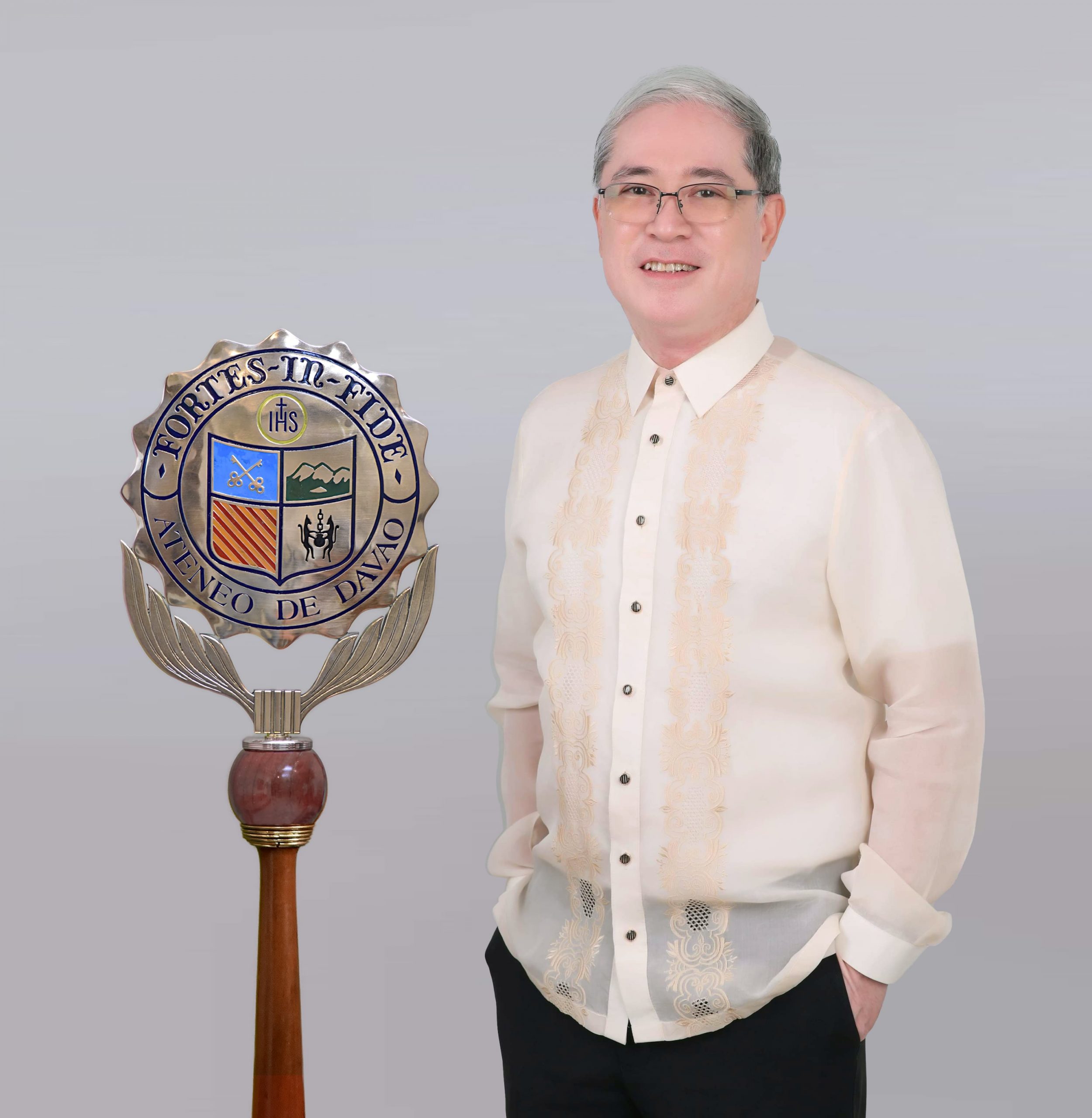
Rev. Fr. Karel S. San Juan, SJ
President
Ateneo de Davao University
As a Jesuit, he has held leadership positions in the Simbahang Lingkod ng Bayan, Center for Ignatian Spirituality, San Jose Seminary, Jesuit Higher Education Commission, Commission on Ministries, and Emmaus Center for Psycho-Spiritual Formation. At Emmaus Center, he developed programs related to formation for formators, formative leadership, psychotherapeutic treatment, and continuing care of Church personnel.
Fr. San Juan served as the President of Ateneo de Zamboanga University from October 2013 to March 2023. Through these years, he navigated several challenges, including the Zamboanga siege, terrorist threats, the K-12 transition, and the COVID-19 pandemic. He launched rebuilding and fundraising initiatives after a fire. He led the creation of a new campus from a generous benefaction. He facilitated the university’s responses to several city and regional socio-economic-political challenges, including support for the Bangsamoro region. The university reinforced its leadership in the region in academic excellence, social development, and integral formation.
In September 2023, he assumed the role as President of Ateneo de Davao University.